



7 Health Lies We Were Taught to Believe
For decades we were told to fear fat.
Avoid the sun.
Cut salt.
Eat processed “low-fat” food.
We followed the rules.
And yet chronic illness exploded.
Obesity tripled.
Diabetes skyrocketed.
Energy collapsed.
Meanwhile entire industries became billion-dollar empires selling products to “fix” the problems those messages helped create.
Something doesn’t add up.
When you step back and look at the messages that shaped modern nutrition culture, a different picture begins to emerge.
Here are seven beliefs that deserve a serious second look.
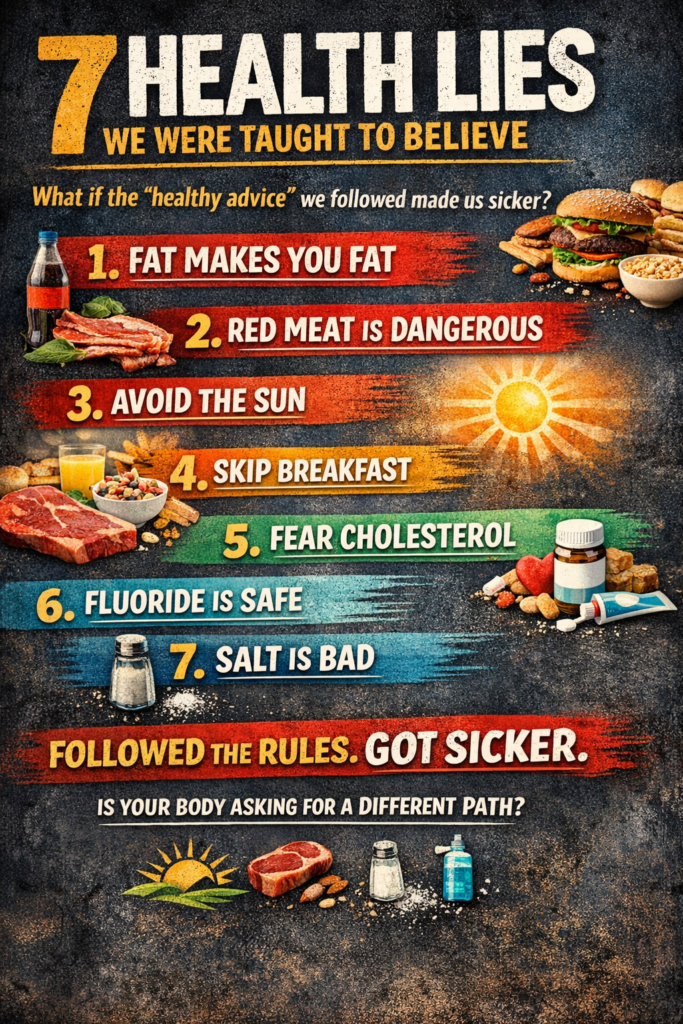
1. “Fat makes you fat.”
For years fat was treated like the villain of the human diet.
But every cell in your body is wrapped in fat.
Your brain is largely fat.
Your hormones are built from cholesterol and fatty acids.
Fat isn’t foreign to your body. It’s foundational.
When fat was stripped from food in the late 20th century, it wasn’t replaced with vegetables and whole foods.
It was replaced with sugar and refined carbohydrates.
Low-fat products flooded grocery stores.
At the exact same time obesity and type-2 diabetes began rising rapidly.
The problem may never have been natural fats.
The real shift was toward ultra-processed food.
2. “Red meat is dangerous.”
Red meat is often placed in the same category as processed deli meats, hot dogs, and packaged meats.
But humans have eaten meat for thousands of years.
Long before the modern explosion of metabolic disease, people relied on meat for protein, iron, B-vitamins, and essential nutrients.
The larger issue may not be whole foods like properly sourced meat.
It may be the massive rise of ultra-processed food that replaced real meals.
Food context matters.
How something is produced, prepared, and balanced in the diet makes a difference.
3. “Avoid the sun.”
Sunlight is one of the most powerful biological signals your body receives.
It regulates circadian rhythm.
Supports vitamin D production.
Strengthens immune function.
Improves mood and hormone balance.
Humans evolved outdoors.
Yet modern life keeps many people inside nearly all day.
Of course excessive sun exposure can be harmful. But complete avoidance has consequences too.
Your body was designed to interact with sunlight.
Moderate exposure is part of how your biology stays regulated.
4. “The intermittent fasting obsession.”
You’ve probably heard that skipping breakfast is the key to metabolic health.
But the body often thrives on rhythm more than restriction.
Eating within about an hour of waking can stabilize blood sugar, support steady energy, and signal safety to the nervous system.
After sleeping all night, your body is ready for two things:
Hydration and nourishment.
Interestingly, most people are already fasting naturally.
If you stop eating in the evening and sleep seven or eight hours, your body has already completed an overnight fast.
There’s often no need to extend that window dramatically.
What supports metabolism most consistently is daily rhythm:
Water in the morning.
Minerals and hydration.
A balanced meal to start the day.
Your body responds to consistency far better than extremes.
5. “The war on cholesterol.”
Cholesterol has been portrayed as a major villain in heart disease.
But cholesterol is essential for life.
It helps build hormones.
Supports brain function.
Repairs cells.
Heart disease is complex. It involves inflammation, metabolic health, lifestyle patterns, and diet quality.
Focusing on one single number without looking at the bigger picture can miss the deeper drivers of disease.
The body is more complex than a lab value.
6. “The fluoride debate.”
Fluoride has long been used in dental care to help reduce cavities.
But discussions continue around exposure levels and long-term health effects.
Like many public health issues, the conversation continues to evolve as more research emerges.
Good science always keeps asking better questions.
7. “Salt is the enemy.”
Salt has been blamed for high blood pressure for decades.
But sodium balance is tied to hydration, mineral intake, stress, and metabolic health.
Many traditional diets around the world contained substantial salt without widespread hypertension.
What changed in modern society wasn’t just salt.
It was the explosion of processed foods, refined sugar, sedentary lifestyles, and chronic stress.
The full picture matters.
Today millions of people live with fatigue, brain fog, inflammation, anxiety, and metabolic problems.
Too often the next step is simply medication.
But many of these symptoms can also reflect something deeper:
Nutrient depletion.
Stress physiology.
Poor sleep.
Disrupted daily rhythms.
Sometimes the body isn’t malfunctioning.
Sometimes it’s responding to what it has been given — or what it has been missing.
Healing rarely starts with extreme interventions.
More often it begins with the fundamentals:
Real food
Minerals and hydration
Sunlight
Movement
Nervous system regulation
Consistent daily rhythms
Your body is not broken.
More often than not, it is simply asking for what it needs.